
cics northtown
course catalog
School Year 2025-2026
Course Selection Information
course catalog guidance
This course catalog is designed to help students create a 4-year plan and to track progress toward graduation. In addition, the catalog offers students the opportunity to identify and explore opportunities to develop new interests, sharpen particular academic skills, reflect on career options, and prepare for college.
Every year, students should review the graduation requirements and their report cards to determine which credits are completed and which are remaining. Students will meet with their counselor to plan for the upcoming school year and register for classes.
As you read the catalog, keep in mind the following:
- 1.0 credit courses are a full year
- 0.5 credit courses are a semester
- Some courses require a fee. Students are required to pay those fees in order to receive credit in the course
- All students must also complete 2 Service Learning projects in order to qualify for graduation

Graduation
Requirements

Sample 4
Year Plan

Career Pathway
Guide

Printer Friendly
Course Catalog
Course Registration
CICS Northtown Academy strives to ensure students take classes that meet graduation requirements, college admission guidelines, and/or career pathways. Students work with their school counselor to select classes that match their interests as well as provide the appropriate level of challenge.
Course Selection Timeline
Each year, students will meet with their counselor to select their courses for the following school year based on teacher recommendations and student interests.
- November/December: Administration and teachers review the Course Catalog and suggest new classes.
- January/February: Current teachers provide recommendations
- February: Counselors email a newsletter to students and families about registration. Counselors then meet with students to review the course catalog, revise 4-year plans, review recommendations, and register for classes.
- March: Staffing and master schedule building begins
Course Availability
All courses listed in this catalog require a sufficient number of student requests in order to run. Sectioning and staffing are completed based on the number of student requests. Due to the number of requests, master schedule issues, or conflicts with courses, students may not get all courses they requested. As a result, students are encouraged to select alternatives.
Course Recommendation/Placements: Incoming Freshman
Northtown uses a variety of data points to determine freshman placement in classes, including but not limited to: IXL scores, Northtown placement tests, and standardized test scores.
Course Recommendation/Placements: Sophomores - Seniors
Teachers recommend students for next year’s courses by reviewing: GPA, grades, IXL scores, teacher observation of skill achievement, and student input. Teachers also review the needs of diverse learners and English language learners.
Students who wish to take a class that differs from their recommendation will complete the following steps:
- Students review course recommendations with the school counselor during the registration meeting.
- Per student request, the school counselor emails teacher, instructional coach, and student stating the desired course the student wants to take and seeking additional information around the teacher’s course recommendation.
- The student and school counselor will discuss the teacher’s response. If the teacher provides a new recommendation for the student’s desired course, the student is registered for the class. If the teacher does not support a recommendation for the student’s desired course and the student still wants to pursue the desired course, the student and family will sign a Course Level Change Request Form.
Course Scheduling
Each year a new master schedule is built based on student course selections. Once the schedule is built, school counselors will individually review schedules to ensure that all students are in the correct level of classes and meet graduation requirements.
Schedule Corrections
Schedule corrections are completed during the first 3 days of the school year for the following circumstances:
- Student is changing class levels
- Student earned class credit during summer school or credit recovery
- Student is missing a graduation requirement
- Student has an adjustment in their needs based on special education services or English Language Learner supports.
- Student was scheduled into a class they previously completed.
- Student wants an Academic Lab as opposed to an elective class.
School counselors do NOT make changes to schedules for preferred electives, class periods, lunch periods, or teachers.

Instructional
(INSTR)
Academic
Honors
Dual Credit &
Dual Enrollment
Advanced Placement (AP)
Early College Opportunities
Students can earn college credit during high school by taking AP courses, Dual Credit courses, and Dual Enrollment courses.
AP Course
College-level class taken at Northtown. Successful completion of the AP Exam at the end of the school year can result in earning college credit. AP classes are a full-year commitment. After the first 3 days of school, students will not be able to drop AP courses.
Options: AP English Literature & Composition, AP Language & Composition, AP Human Geography, AP World History, AP US History, AP US Government & Politics, AP Psychology, AP Biology, AP Computer Science Principles, AP Spanish Language, AP Pre Calculus, AP Calculus AB
Dual Credit Course
College courses taken at Northtown for both high school credit and college credit. Students must meet minimum GPA, attendance, and testing requirements to enroll. Completion of the class with a “C” grade or higher results in earning college credit.
Chicago City College Options: English 101: Composition Dual Credit, English 102: Composition Dual Credit, Art 103: Art Appreciation Dual Credit, Art 127: Printmaking Dual Credit; Theater Arts 132: Theater Production & Directing Dual Credit; Theater Arts 133: Acting 1 Dual Credit
Northeastern Illinois University Options: Dance 131: Intro to Spanish Dance Dual Credit
Dual Enrollment Course
College courses taken at one of the Chicago City Colleges for both high school credit and college credit. Students must meet minimum GPA, attendance, and testing requirements to enroll. Completion of the class with a “C” grade or higher results in earning college credit. Options: See page 21 for more details on Dual Enrollment course options and requirements.
If a student withdraws from a Chicago City College Dual Credit or Dual Enrollment course or earns below a “C” grade, the student must meet with Northtown’s Dual Enrollment Coordinator to discuss whether the student can enroll in a future Dual Credit or Dual Enrollment course.
English courses
English 1 Instructional: Multicultural Literature
This course equips readers with competency and confidence in four areas: academic reading, reading for global engagement, reading for community engagement, and reading literature. It heavily emphasizes nonfiction texts and media, and intentionally incorporates diverse voices and perspectives. The ultimate goal is for students to have flexibility, functionality, and the ability to self-calibrate while facing complex texts across disciplines for a variety of purposes.
English 1: Multicultural Literature
This course equips readers with competency and confidence in four areas: academic reading, reading for global engagement, reading for community engagement, and reading literature. It heavily emphasizes nonfiction texts and media, and intentionally incorporates diverse voices and perspectives. The ultimate goal is for students to have flexibility, functionality, and the ability to self-calibrate while facing complex texts across disciplines for a variety of purposes.
English 1: Multicultural Literature Honors
This course equips readers with competency and confidence in four areas: academic reading, reading for global engagement, reading for community engagement, and reading literature. It heavily emphasizes nonfiction texts and media, and intentionally incorporates diverse voices and perspectives. The ultimate goal is for students to have flexibility, functionality, and the ability to self-calibrate while facing complex texts across disciplines for a variety of purposes.
English 1 ESL: Multicultural Literature
This course equips readers with competency and confidence in four areas: academic reading, reading for global engagement, reading for community engagement, and reading literature. It heavily emphasizes nonfiction texts and media, and intentionally incorporates diverse voices and perspectives. The ultimate goal is for students to have flexibility, functionality, and the ability to self-calibrate while facing complex texts across disciplines for a variety of purposes.
English 2 Instructional: World Literature & Composition
Sophomore students will engage in the reading of works from a variety of places and perspectives to understand how universal themes span culture and time periods. Through the use of a variety of anchor and mentor texts and supplemental works (novel, short stories, poems, articles, etc.), students will further develop their ability to interpret and analyze literary and information selections. Students continue to develop more precise literary analysis skills, and write argument pieces, focusing on the skills of topic development, organization, diction/syntax and the use of textual evidence.
English 2: World Literature & Composition
Sophomore students will engage in the reading of works from a variety of places and perspectives to understand how universal themes span culture and time periods. Through the use of a variety of anchor and mentor texts and supplemental works (novel, short stories, poems, articles, etc.), students will further develop their ability to interpret and analyze literary and information selections. Students continue to develop more precise literary analysis skills, and write argument pieces, focusing on the skills of topic development, organization, diction/syntax and the use of textual evidence.
English 2: World Literature & Composition Honors
Sophomore students will engage in the reading of works from a variety of places and perspectives to understand how universal themes span culture and time periods. Through the use of a variety of anchor and mentor texts and supplemental works (novel, short stories, poems, articles, etc.), students will further develop their ability to interpret and analyze literary and information selections. Students continue to develop more precise literary analysis skills, and write argument pieces, focusing on the skills of topic development, organization, diction/syntax and the use of textual evidence.
English 2 ESL: World Literature & Composition
Sophomore students will engage in the reading of works from a variety of places and perspectives to understand how universal themes span culture and time periods. Through the use of a variety of anchor and mentor texts and supplemental works (novel, short stories, poems, articles, etc.), students will further develop their ability to interpret and analyze literary and information selections. Students continue to develop more precise literary analysis skills, and write argument pieces, focusing on the skills of topic development, organization, diction/syntax and the use of textual evidence.
English 3 Instructional American Literature & Composition
American identity through multicultural, canonical and non-fiction texts. This course will explore American literature from the Puritan era to Post-Modernism, paying specific attention to the history of the periods and the influences of race, class, and gender on society. This course, through the analysis of each work, will study history through literature. Texts will include the novel, drama, non-fiction, poetry, and short story. Students will be able to incorporate grammar skills into the writing they are doing about their reading.
English 3: American Literature & Composition
American identity through multicultural, canonical and non-fiction texts. This course will explore American literature from the Puritan era to Post-Modernism, paying specific attention to the history of the periods and the influences of race, class, and gender on society. This course, through the analysis of each work, will study history through literature. Texts will include the novel, drama, non-fiction, poetry, and short story. Students will be able to incorporate grammar skills into the writing they are doing about their reading.
English 3: American Literature & Composition Honors
American identity through multicultural, canonical and non-fiction texts. This course will explore American literature from the Puritan era to Post-Modernism, paying specific attention to the history of the periods and the influences of race, class, and gender on society. This course, through the analysis of each work, will study history through literature. Texts will include the novel, drama, non-fiction, poetry, and short story. Students will be able to incorporate grammar skills into the writing they are doing about their reading.
English 3 ESL: American Literature & Composition
American identity through multicultural, canonical and non-fiction texts. This course will explore American literature from the Puritan era to Post-Modernism, paying specific attention to the history of the periods and the influences of race, class, and gender on society. This course, through the analysis of each work, will study history through literature. Texts will include the novel, drama, non-fiction, poetry, and short story. Students will be able to incorporate grammar skills into the writing they are doing about their reading.
English 3: African American Literature Honors
African American literature explores the literary tradition in shaping both the identities and the histories of African Americans in the United States. In an effort to critically map the genealogies of this tradition, the course material will investigate not only the historical and political contexts of the works, but also the ways in which issues of gender, sexuality, and class specifically inform the works. In addition, this course focuses on vocabulary development, reading and critically analyzing literature, understanding the way writers use language to provide meaning and pleasure, the consideration of a work‘s structure, style and themes as well as smaller scale elements. Students will further their study and research skills, cooperative learning skills, critical thinking skills, and writing skills.
AP Language & Composition
Students in this Advanced Placement, introductory college-level course read and carefully analyze a broad and challenging range of nonfiction and fiction prose selections, deepening their awareness of rhetoric and how language works. Through close reading and frequent writing, students develop their ability to work with language and text with a greater awareness of purpose and strategy, while strengthening their own composing abilities. Course readings feature expository, analytical, personal, and argumentative texts from a variety of authors and historical contexts.
English 4 Instructional: Survey of Literature
Students will take a year-long English Literature Course that covers an array of literature. Students will be reading, analyzing, and writing in this class.
English 4 ELL
Students will continue to develop essential reading, writing, speaking, and listening skills through the study of a variety of diverse texts. They explore questions of identity and culture. Another major focus of the course is to continue to facilitate growth in both content-specific and conversational English. The materials in this class, along with the skills are aligned to WIDA, ELD standards, SAT, and CCSS.
English 4: Personal Essay (S1) & Modern Poetry (S2)
In this course, students will begin the year learning about how to compose the Personal Essay in anticipation for the college application process. Students will receive a comprehensive overview of the process for crafting the personal essay and will receive individualized support for successful completion. During Semester 2, this course will transition to a focus on modern poetry, which will be explored through formal discussions, analysis, and composition. This modern poetry class will emphasize the reading and analyzing of classic and contemporary poems and offer a workshop in poetry.
English 4: Personal Essay (S1) & Short Stories (S2)
In this course, students will begin the year learning about how to compose the Personal Essay in anticipation for the college application process. Students will receive a comprehensive overview of the process for crafting the personal essay and will receive individualized support for successful completion. During Semester 2, this course will transition to a focus on short stories, which will be explored through formal discussions, analysis, and composition. This short story class will focus on classic short stories as well as feature flash fiction.
AP English Literature & Composition
AP English Literature engages students in the careful reading and critical analysis of imaginative literature. Through the close reading of selected texts, students deepen their understanding of the way writers use language to provide both meaning and pleasure for their readers.
Writing courses
Composition 1
Composition courses focus on students’ writing skills and develop their ability to compose different types of papers for a range of purposes and audiences. These courses enable students to explore and practice descriptive, narrative, persuasive, or expositive styles as they write paragraphs, essays, letters, applications, formal documented papers, or technical reports. Although composition courses may present some opportunities for creative writing, their focus usually remains on nonfiction, scholarly, or formal writing.
Composition 2
Composition courses focus on students’ writing skills and develop their ability to compose different types of papers for a range of purposes and audiences. These courses enable students to explore and practice descriptive, narrative, persuasive, or expositive styles as they write paragraphs, essays, letters, applications, formal documented papers, or technical reports. Although composition courses may present some opportunities for creative writing, their focus usually remains on nonfiction, scholarly, or formal writing.
Public Speaking
The number one fear for most people is public speaking. This class will not only talk about how to overcome this fear, but will help you become a confident public speaker. We will give impromptu speeches, research speeches, group speeches, and persuasive speeches.
Journalism
This year-long course will function as an introduction to journalism. Students will learn about the history of journalism and the Society of Professional Journalists Code of Ethics. Students will study news writing, editing, photography, layout and page design. They will then apply these skills to produce the school yearbook.
Film Studies
In Film Studies, we learn to analyze film and how a director expresses his/her vision in film. We begin the year examining what makes a “great” film then focus on analyzing and evaluating a variety of “American Voices” in genre film (horror, romantic comedy, sci-fi, western).
Philosophy and Literature
Students will learn the basics of ancient and modern philosophy. The goals for the class are to...Enable you to think about who you are and why we are here. Develop a foundation of philosophy. Encourage you to think for yourself and develop your own opinions. Learn how to apply philosophical thought to all types of literature.
Mythology
Students will learn about Greek, Norse, and many Middle Eastern Mythologies. From Anubis (Egyptian) to Zeus (Greek), students will learn the foundations of storytelling, and how those stories inform modern day people about ancient civilizations.
Science Fiction Literature and Media
This course evaluates potential futures through science fiction texts and media with non fiction, real world applications. The course looks at the best and worst future possibilities if present trends in society and present human traits continue.
English 101: Composition Dual Credit
Completion of this class with a “C” grade or higher will earn the student 3 college credits from Wright College, transferable to other universities to take the place of an introduction to college writing course. Development of critical and analytical skills in writing and reading of expository prose. Writing assignments are part of the course. (This is a semester class, but students will earn 1.0 high school credits due to its college level.)
English 102: Composition Dual Credit
Completion of this class with a “C” grade or higher will earn the student 3 college credits from Wright College, transferable to other universities to take the place of an introduction to college writing course. As a continuation of English 101, the class introduces methods of research and writing of investigative papers. Writing assignments are part of the course. (This is a semester class, but students will earn 1.0 high school credits due to its college level.)
Courses for English Language Learners
ESL 1/2
With a focus on communication, ESL 1/2 supports students new to acquiring English in the development of their emerging reading, writing, listening, and speaking skills. Students in this class also learn essential skills that will help them navigate life in the U.S. Students will also have the opportunity to learn and/or enhance computer skills essential for high school success, along with creating and completing a community service project as a class.
ESL 3/4
ESL 3/4 is a transitional ELA class for English Language Learners. It is designed to provide students with the opportunity to continue to develop essential reading, writing, speaking, and listening skills through the study of a variety of diverse texts, including poetry, short stories, novels, and plays. They explore questions of identity and culture, while working in a collaborative setting. Another major focus of the course is to continue to facilitate growth in both content-specific and conversational English. Students will also have the opportunity to learn and/or enhance computer skills essential for high school success, along with creating and completing a community service project as a class. The materials in this class, along with the skills are aligned to WIDA, ELD standards, SAT, and CCSS.
Writing 1 ELL
In Writing I ELL, students continue to develop essential reading, writing, speaking, and listening skills through the study of a variety of diverse texts, including poetry, short stories, novels, and plays. Using these model texts, students will acquire and develop English writing and grammar skills that will prepare them for both success on standardized tests and overall clearer communication.
Co-taught classes for Multilingual Learners
Certified ESL teachers push into history, social studies, and science classes to help teach the language of the content area. The focus is on developing reading, writing, speaking and listening skills in that specific content area. This instruction can be provided to Part-time and Full-time ELLs and students in both the TBE and TPI programs.
Spanish Language Arts (Spanish Heritage 1, Spanish Heritage II, and AP Spanish Lang) and Arabic Language Arts (Arabic Heritage I, Arabic Heritage II) are offered by NTA’s World Language Teachers. See the World Language section for more details.
Co-taught Classes for Multilingual Learners
Certified ESL teachers push into history, social studies, and science classes to help teach the language of the content area. The focus is on developing reading, writing, speaking and listening skills in that specific content area. This instruction can be provided to Part-time and Full-time ELLs and students in both the TBE and TPI programs.
Spanish Language Arts (Spanish Heritage 1, Spanish Heritage II, and AP Spanish Lang) and Arabic Language Arts (Arabic Heritage I, Arabic Heritage II) are offered by NTA’s World Language Teachers. See the World Language section for more details.
Social Studies courses
Human Geography
Human Geography introduces students to the systematic study of patterns and processes that have shaped human understanding, use, and alteration of Earth's surface. Students employ spatial concepts and landscape analysis to examine socio economic organization and its environmental consequences. They also learn about the methods and tools geographers use in their research and applications.
Human Geography Instructional
Human Geography introduces students to the systematic study of patterns and processes that have shaped human understanding, use, and alteration of Earth's surface. Students employ spatial concepts and landscape analysis to examine socio economic organization and its environmental consequences. They also learn about the methods and tools geographers use in their research and applications.
AP Human Geography
The AP Human Geography course is equivalent to an introductory college-level course in human geography. The course introduces students to the systematic study of patterns and processes that have shaped human understanding, use, and alteration of Earth's surface. Students employ spatial concepts and landscape analysis to examine socio-economic organization and its environmental consequences. They also learn about the methods and tools geographers use in their research and applications.
World History
A survey history class focusing primarily on reading skills, study skills, and historical thinking skills. The course begins with the Big Bang and ends with modern day history and conversations on the future. Throughout the year, the course discusses significant thresholds between time periods, important cultural and political characteristics of various societies to provide students with a general understanding of the course of human history. Students are taught to engage history through a variety of learning experiences and consider information in many formats and from countless sources.
AP World History
The AP World History course focuses on developing students’ understanding of world history from approximately 8000 BCE to the present. This college-level course has students investigate the content of world history for significant events, individuals, developments, and processes in six historical periods, and develop and use the same thinking skills and methods (analyzing primary and secondary sources, making historical comparisons, chronological reasoning, and argumentation) employed by historians when they study the past.
U.S. History
United States History aims to engage students in studying the political, social and economic development of the United States from the pre-colonial period through contemporary hs. Students will especially focus on how the current American political system was established, challenged and threatened. Students will also focus on various social attitudes, norms, movements, and standards that have shaped public American attitudes today. In all, students will be expected to think critically about American history—its institutions, political figures, and social norms—in order to better understand the America we live in today.
AP U.S. History
The AP U.S. History course focuses on developing students’ understanding of American history from approximately 1491 to the present. The course has students investigate the content of U.S. history for significant events, individuals, developments, and processes in nine historical periods, and develop and use the same thinking skills and methods (analyzing primary and secondary sources, making historical comparisons, chronological reasoning, and argumentation) employed by historians when they study the past. That students explore throughout the course in order to make connections among historical developments in different times and places.
Civics
History is the study of how the world used to be, Civics is the study of how the world could and should be, with a peak behind the curtain to examine how government actually functions. What does it mean to be civilized? How do members of civilized society organize themselves? What sacrifices must be made for the good of the entire society? We try to answer these questions in civics, focusing on the rights and responsibilities of citizens of the United States and state of Illinois. As part of this class, students must pass the Constitution Test.
Social Studies Electives
Economics
Economics explores how humans behave when faced with a choice. Should I go to college or not? Should I spend my money on new clothes or save it? We will look at what is gained and what is lost when you make any choice.
Psychology
Students explore introductory psychological concepts. The class focuses on how our behavior is influenced by our brain, and vice versa. Areas of study include the biology of the brain, learning, memory, and the human life cycle. Students will be challenged to use their own personal experiences as a reference to psychological concepts from class. Counts as Writing Elective credit.
Sociology
This is an elective course that looks at the behavior of people and groups with a focus on culture, socialization, social interaction, race, gender, class, and deviance. It is an introductory-level class, so there are no prerequisites. Also, this class has a heavy emphasis on projects, film, and group-based learning. Counts as Writing Elective credit.
Chicago History
Chicago History will build upon students' historical thinking skills and experiences to delve into the multi-faceted and multicultural history of our city. Topics may include Chicago neighborhoods, immigrant history, labor history, as well as areas of students' choice. With the city as our classroom, we will explore different geographical and historical moments, movements, and personalities and conduct original research. Counts as Writing Elective credit.
Law
Law students analyze the way justice is defined, perceived, and employed in modern society. Law engages in an in-depth study of constitutional law, one that goes beyond what you’ve learned in U.S. History and Economics/Civics.
This portion of the course looks at current, precedent setting cases. Mock Trials are a major part of law class. Our study of criminal and civil law addresses specific legal processes, concepts, and standards. Counts as Writing Elective credit.
AP Psychology
The AP Psychology course is designed to introduce students to the systematic and scientific study of the behavior and mental processes of human beings and other animals. Students are exposed to the psychological facts, principles, and phenomena associated with each of the major subfields within psychology. They also learn about the ethics and methods psychologists use in their science and practice. Counts as Writing Elective credit.
AP United States Government and Politics
This course introduces students to key political ideas, institutions, policies, interactions, roles, and behaviors that characterize the political culture of the United States. The course examines politically significant concepts and themes, through which students learn to apply disciplinary reasoning, assess causes and consequences of political events, and interpret data to develop evidence-based arguments. AP US Government fulfills Civics credit.
Science courses
Physical Science
Physical Science is a lab based course that combines the traditional college preparatory courses of biology, chemistry and physics. This curriculum covers four units of scientific study in the span of one academic year. Successful completion of the Physical Science program fully prepares the students with skills to be used in college-preparatory courses such as biology, physics, chemistry and AP-level science courses.
Physical Science Instructional
Physical Science is a lab based course that combines the traditional college preparatory courses of biology, chemistry and physics. This curriculum covers four units of scientific study in the span of one academic year. Successful completion of the Physical Science program fully prepares the students with skills to be used in college-preparatory courses such as biology, physics, chemistry and AP-level science courses.
Chemistry
This course explores the question, what is everything around me made of? In seeking the answer to this question students access computer simulations to learn about atoms, molecules, compounds, and chemical bonds. Experiments are utilized to explore how acids and bases react when mixed together. Demonstrations allow students to witness what happens to solids, liquids, and gases under varying conditions. Inquiry activities encourage students to explore how heat and nuclear reactions alter the world around us, for better or for worse. Students leave this course with an understanding of how the physical world functions at a microscopic level.
Chemistry Honors
This course explores the question, what is everything around me made of? In seeking the answer to this question students access computer simulations to learn about atoms, molecules, compounds, and chemical bonds. Experiments are utilized to explore how acids and bases react when mixed together. Demonstrations allow students to witness what happens to solids, liquids, and gases under varying conditions. Inquiry activities encourage students to explore how heat and nuclear reactions alter the world around us, for better or for worse. Students leave this course with an understanding of how the physical world functions at a microscopic level.
Biology
This course will enable students to understand and appreciate the importance of biology by examining the diverse systems of life. This upper-level class is designed to prepare students for college level biology courses. Emphasis will be placed on the molecular basis of life and include investigations in bioethics, evolution, genetics, and the changing environment. Students will integrate concepts that they have learned in chemistry, physics, and physical science to synthesize their scientific learning in high school.
Biology Honors
This course will enable students to understand and appreciate the importance of biology by examining the diverse systems of life. This upper-level class is designed to prepare students for college level biology courses. Emphasis will be placed on the molecular basis of life and include investigations in bioethics, evolution, genetics, and the changing environment. Students will integrate concepts that they have learned in chemistry, physics, and physical science to synthesize their scientific learning in high school.
Science Electives
Aquatic Science
Aquatic Science is the study of the marine and freshwater ecosystems. This course focuses on the habitats and its inhabitants of different ecosystems found in the world. Students will also investigate the human impact on aquatic ecosystems and what it may lead to in the future. NTA has partnered with Shedd Aquarium to bring resources into the classroom and give students opportunities to visit and speak with professionals involved in aquatic science.
Forensics
Forensic science is the process of using science to solve crimes. Students in this course will learn how to collect evidence found at a crime science and then how to properly analyze this evidence. Topics covered in this course will include fingerprinting, blood and blood spatter analysis, hair and fiber examination, DNA analysis, and toxicology. Forensic science is rich in exploration and lab investigation which applies many disciplines of scientific study such as biology, anatomy, chemistry, and physics to solving crimes.
Anatomy and Physiology
This class is the study of the structure and function of the human body. This course focuses on answering the question, how does a human body function normally and what happens when it breaks down? Each unit in this course will focus on the anatomy of different systems in the human body such the muscular, skeletal, circulatory, respiratory, nervous and reproductive system. Students will investigate the diseases and disorders that can affect each of these symptoms and find possible solutions. This class provides a hands-on learning experience in which laboratory work includes dissection of preserved specimens, microscopic study, physiologic experiments, computer simulations, and multimedia presentations.
Physics
This course provides mathematical and conceptual exposure to the fundamental principles and processes of the physical universe. Topics include motion, forces, momentum, orbits, energy, heat, electricity, magnetism, and electromagnetic radiation. Upon completion, students are able to explain any phenomena observed in the universe both conceptually and mathematically. Demonstrations, experiments, inquiry activities, computer simulations, and design builds are utilized to create a hands-on experience.
Physics Honors
This course provides mathematical and conceptual exposure to the fundamental principles and processes of the physical universe. Topics include motion, forces, momentum, orbits, energy, heat, electricity, magnetism, and electromagnetic radiation. Upon completion, students are able to explain any phenomena observed in the universe both conceptually and mathematically. Demonstrations, experiments, inquiry activities, computer simulations, and design builds are utilized to create a hands-on experience.
AP Biology
AP Biology is a college-level biology course. Students cultivate their understanding of biology through inquiry-based investigations as they explore the following topics: evolution, cellular processes, energy and communication, genetics, information transfer, ecology, and interactions. This course requires that 25 percent of the instructional time will be spent in hands-on laboratory work, with an emphasis on inquiry-based investigations that provide students with opportunities to apply the science practices.
Mathematics courses
Algebra 1
In Algebra 1, students gain an understanding of the properties of real numbers and formalize the language of functions, including linear and quadratic. Students explore the behavior of functions numerically, graphically, analytically, and verbally. Students use technology to discover relationships, test inferences, and solve problems. Students write expressions, equations, and inequalities from physical models. A graphing calculator is required.
Algebra 1 Honors
In Algebra 1, students gain an understanding of the properties of real numbers and formalize the language of functions, including linear and quadratic. Students explore the behavior of functions numerically, graphically, analytically, and verbally. Students use technology to discover relationships, test inferences, and solve problems. Students write expressions, equations, and inequalities from physical models. A graphing calculator is required.
Algebra 1 Instructional
In Algebra 1, students gain an understanding of the properties of real numbers and formalize the language of functions, including linear and quadratic. Students explore the behavior of functions numerically, graphically, analytically, and verbally. Students use technology to discover relationships, test inferences, and solve problems. Students write expressions, equations, and inequalities from physical models. A graphing calculator is required.
Math Foundations
In Math Foundations, students begin to formalize their learning from the middle grades to make connections across mathematical concepts. Students study both algebraic and geometric patterns to discover relationships and justify their reasoning. All students should regularly be engaged in the Standards for Mathematical Practice as defined by the Common Core. Mathematical content should be addressed through the study of big ideas allowing students to see the connections between multiple concepts.
Geometry
In Geometry, students develop reasoning and problem solving skills as they study topics such as congruence and similarity, and apply properties of lines, triangles, quadrilaterals, and circles. Students also develop problem solving skills by using length, perimeter, area, circumference, surface area, and volume to solve real-world problems. A graphing calculator is required.
Geometry Honors
In Geometry, students develop reasoning and problem solving skills as they study topics such as congruence and similarity, and apply properties of lines, triangles, quadrilaterals, and circles. Students also develop problem solving skills by using length, perimeter, area, circumference, surface area, and volume to solve real-world problems. A graphing calculator is required.
Geometry Instructional
In Geometry, students develop reasoning and problem solving skills as they study topics such as congruence and similarity, and apply properties of lines, triangles, quadrilaterals, and circles. Students also develop problem solving skills by using length, perimeter, area, circumference, surface area, and volume to solve real-world problems. A graphing calculator is required.
Algebra 2
The content of Algebra 2 is organized around families of functions, including polynomial, exponential, radical, and rational functions. Students work with functions graphically, numerically, analytically, and verbally, as well as in real-world situations. A graphing calculator is required.
Algebra 2 Honors
The content of Algebra 2 is organized around families of functions, including polynomial, exponential, radical, and rational functions. Students work with functions graphically, numerically, analytically, and verbally, as well as in real-world situations. A graphing calculator is required.
Algebra 2 Instructional
The content of Algebra 2 is organized around families of functions, including polynomial, exponential, radical, and rational functions. Students work with functions graphically, numerically, analytically, and verbally, as well as in real-world situations. A graphing calculator is required.
Precalculus
Upon successful completion of this course, students are able to analyze and graph functions, including linear, quadratic, polynomial, rational, exponential, and logarithmic. Students will also be able to apply these functions to application problems. Students justify their reasoning and understanding with models. A graphing calculator is required.
AP Pre-Calculus
In AP Precalculus, students explore everyday situations using mathematical tools and lenses. Through regular practice, students build deep mastery of modeling and functions, and they examine scenarios through multiple representations. This course focuses on 3 major units: Polynomial & Rational Functions, Exponential & Logarithmic Functions, and Trigonometric & Polar Functions.
Math Application Instructional
Math Application is an integral part of our students' everyday life. It is crucial for our students to develop the math skills necessary for solving a wide range of problems encountered in the real world. In this class students receive clear simple directions and short activity questions and sentences written at a low reading level. The activities feature realistic graphic representations that our students already encounter or will soon encounter. There are 6 units that introduce real-world math skills and cover shopping, banking, budgeting, food, health, travel and school. Students will learn to apply a variety of math strategies to real world situations, identify and analyze information needed to solve math problems, build new math knowledge through problem solving, and solve problems that arise in mathematics and in other contexts. Math Application Instructional fulfills Consumer Education credit.
Transitional Math
Completion of this class with a “C” grade or higher earns guaranteed placement in college level math at any Illinois community college (no math placement exam required). This course develops students' math skills to prepare them to take college level math. Upon completion students will demonstrate proficiency in whole numbers, integers, fractions, and decimals, use estimation and explain/justify estimates, apply quantitative reasoning to solve problems involving quantities or rates, use mathematical summaries of data such as mean, median, and mode, use and apply algebraic reasoning as one of multiple problem-solving tools, and use functions and modeling processes. Authentic application, problem-based instruction designed to build mathematical conceptual understanding and critical thinking skills.
Personal Finance
Students will survey the basic personal financial needs of most individuals. This course emphasizes the fundamentals of budgeting, saving, checking, investments, credit, the wise use of insurance, and paying and preparing income tax returns. Students will build confidence in their own financial decision-making and work towards empowering themselves to save, budget, avoid debt, spend wisely, and invest. Personal Finance fulfills Consumer Education credit.
Statistics
Statistics includes the study of: basic descriptive statistics including frequency distributions, mode, mean and standard deviation; permutations, combinations, probability rules and Bayes Theorem; binomial and normal distributions; basic inferential statistics including sampling theory, confidence intervals for means and proportions, test of hypotheses; chi-square distribution; and introduction to correlation and regression. A graphing calculator is required.
Calculus Honors
This course introduces students to the fundamental topics in Calculus. Students will study limits of functions, continuity, derivatives, and integrals. A graphing calculator is required.
AP Calculus AB
AP Calculus AB is an introductory college-level calculus course. Students cultivate their understanding of differential and integral calculus through engaging with real-world problems represented graphically, numerically, analytically, and verbally and using definitions and theorems to build arguments and justify conclusions as they explore concepts like change, limits, and the analysis of functions.
World Language courses
Spanish 1
This course introduces students to Spanish language and culture through a story-telling environment based on comprehensible input and 90% of class time spent in the target language. The objective of this course is to develop communication through listening, speaking, reading, and writing in everyday situations. The foreign language program also aims to develop an understanding and appreciation of the customs, and cultures, of Spanish speaking societies. Integral parts of this course include class participation, vocabulary, and grammar.
Spanish 1 for Heritage Speakers
This introductory world language heritage course focuses on fine-tuning each student’s ability in the following four skill areas: listening comprehension, reading, writing, and speaking. Emphasis is placed on current grammar skills in writing and speaking, in order to scaffold in an approach to professional-level fluency. Reading from modern and contemporary Spanish literature will be included, as well as films, and recorded material, to improve the student’s conversation, composition, reading and listening skills.
Spanish 2
This course builds upon the materials and skills acquired during the student’s first year. In this intermediate language course, students continue the skill development and understanding of Spanish cultures. Students will expand their vocabulary through storytelling and with further emphasis on reading and writing skills. Student usage of Spanish in the classroom is an integral part of student participation. They will begin the year with a review of SP 1 and move on to practicing their grammar skills in the past tense.
Spanish 2 for Heritage Speakers
This course is designed to develop Spanish-speaking heritage language learners' academic language within various vocational settings while also starting to develop skills used in AP Spanish. Academic skills cover students’ abilities to listen, speak, read, and write in the target language. More focus is placed on students’ ability to read and write in the target language, in both formal and informal academic settings. Cross-curricular unit themes will lead students to be able to analyze a variety of literary texts, engage in an academic discussion, produce persuasive speech, write expository and directive texts, and finally construct formal petitions in writing.
Spanish 3
Spanish 3 is an intermediate course for students who wish to gain better fluency and understanding of a foreign language. The course is intended to further develop skills in each of the major communication domains: listening, reading, speaking, and writing. Major emphasis is placed on developing the ability to communicate fluently with accurate pronunciation/intonation and sentence structure, in a variety of authentic contexts. Emphasis is also placed on fostering an appreciation of the culture of Spanish-speaking countries through the study of history, literature, music, art, dance, etc. Integral parts of this course include class participation, vocabulary, and grammar.
AP Spanish Language and Culture
In this college-level course, students focus on developing their three modes of communication: interpretive, interpersonal and presentational. They develop their communicative abilities within six globally themed contexts: families and communities, science and technology, beauty and aesthetic, contemporary life, global challenges, and personal and public identity. Throughout the year, students develop their language skills through activities such as evidence-based classroom discussions and persuasive essay writing. Counts as World Language or Writing Elective credit.
Arabic Heritage I
The main purpose of the Arabic Heritage I at Northtown Academy is to build upon the language knowledge that students bring to the classroom and advance their Arabic proficiency in multiple contexts. Special attention is given to building and acquiring academic vocabulary, effectively using learning strategies, and strengthening composition skills in Arabic. The focus is on the productive skills (speaking and writing) in addition to reading and listening in Modern Standard Arabic (Fus-ha). Students are exposed to grammar as well. Cultural projects and readings reinforce learners' understanding of the multiple issues related to the Arab cultures among the different Arab countries.
Arabic Heritage II
This course builds upon the language knowledge and practice from Arabic Heritage I to continue to advance their Arabic proficiency in multiple contexts. Students practice effectively using Modern Standard Arabic (Fus-ha) in the areas of reading, listening, speaking, and writing. Students continue to build their grammar skills by completing compositions, discussions, and speeches. Cultural projects and readings reinforce learners' understanding of the multiple issues related to the Arab cultures among the different Arab countries. Counts as Writing Elective credit.
Wellness courses
Physical Education 1
Freshman Physical Education has three goals for its students: 1.) Acquire movement skills and understand concepts needed to engage in health enhancing physical activity; 2.) Achieve and maintain a health-enhancing level of physical fitness based on continual self- assessment; and 3.) Develop team-building skills by working with others through physical activity. The skills of team sports will be taught and students will work with others in team situations.
Health
Health will be presented within both disciplinary and interdisciplinary frameworks. The disciplinary will emphasize three major goals: 1.) Understand principles of health promotion and the prevention and treatment of illness and injury; 2.) Understand human body systems and factors that influence growth and development; and 3.) Promote and enhance health and well-being through the use of effective communications and decision-making skills. The interdisciplinary perspective will examine these goals as they relate to public health and current social and political issues, identity, cultural issues involving morality and belief, and global health concerns.
Advanced Physical Education
This class provides students the opportunity to participate in a comprehensive program that consists of: skill development, lead up games, team sports, physical fitness, and individual sports. Students will learn rules, history, and strategies associated with different sports. We will promote the spirit of sportsmanship, fair play, and friendly competition.
Strength and Conditioning
Strength Training is a class that will help improve an individual’s muscular strength and endurance. This course is designed to use weightlifting and assorted workout techniques to increase overall fitness. The focus of this course will be on building muscle, safety and proper exercise technique.
Varsity PE
This course is a PE course that caters to our student athletes. It will focus on training students in a performance setting for their sport(s), educate them on athlete-specific skills across different domains of health, and ultimately prepare them for a college training environment.
Advanced Health
Advanced Health is an experience and discussion-based class that uses a variety of activities, projects and authentic learning opportunities to discover the world of health. Topics include but are not limited to: health care, complementary/alternative medicine, ethics, human sexuality, the war on drugs, quality of life, sports medicine and CPR. Guest speakers from a variety of health care fields, addiction, and other life experiences are incorporated into the curriculum to give it authenticity. This course offers significant opportunities for students to grow through social learning and ultimately have a better understanding of what their own health means to them.
Adventure Ed
Adventure P.E. is offered as a semester course for students interested in a unique Physical Education program that is both physically and mentally challenging. Techniques are taught in class to prepare students for field trips which may include activities such as: indoor climbing walls, outdoor high ropes courses, disc golf and ice skating. The importance of teamwork, group decision making and problem solving is emphasized along with climbing skills and techniques. The class may include an overnight camping trip.
Dance 131: Intro to Spanish Dance Dual Credit
Students will learn the three styles of Spanish Dance: Flamenco, Classical and Folklore-Regional. Students will learn the history, technique, and choreographies of each style and how to incorporate skills learned into their everyday lives. Finally, students will perform a number learned in a final showcase. (This is a semester class, but students will earn 1.0 high school credits due to its college level.)
P.E. Junior Leadership
This semester-long course is offered to students who are interested in developing leadership skills within a Physical Education environment. Students will concentrate on skill development, game strategies, skill analysis, officiating rules and techniques, teaching progressions and methods of organizing and administering various types of activity for classes. A strong emphasis is placed upon the development of responsibility for self and others, leadership skills, and peer teaching. Students enrolled will be able to utilize their leadership qualities by assisting a Physical Education teacher. Responsibilities would include: knowing all students names, leading warm up activities, officiating game play, helping students with skill development, collaboration on assignment and test question creation with the cooperative teacher, occasionally participating in activity when there is an odd number of students, and being a positive role model to younger students.
P.E. Leaders
P.E. Leaders will have an opportunity to assist in physical education courses. Duties will include assisting with warm ups, setting up activities, officiating games, making copies, working in small groups, and other duties as assigned. This course should give the student a practical application on the teaching perspective.
Athletic Physical Education Alternative
Students who participate on a Northtown athletic team can earn physical education credit. Qualifications: Students must pay any applicable athletic fees and maintain a 90% attendance rate or higher for all practices, games, and other required events. At the end of the season, credit will be awarded to athletes in good standing. Pursuing credit for sports participation is optional and not required to be part of a team. Students can earn a maximum of 1.0 Athletic Physical Education Alternative credits throughout High School.
Art & Music Electives
Beginning Band
Semester 1 of this class is Beginning Band. This class is open to students with any amount of musical background. This class focuses on learning the fundamentals of playing traditional concert band instruments (flute, clarinet, saxophone, trumpet, tuba, percussion. Semester 2 of this class is Music Theory. This class is designed to help musicians with the underlying grammar and syntax of musical structure and prepare them to perceive that structure with both the ear and the eye. Emphasis is placed on the basics of musical notation, tonal and melodic structures, and the fundamentals of functional tertian harmony.
Intermediate Modern Band
The Intermediate Modern Band focuses on further development of skills and conceptual knowledge of modern instruments and introduces more in-depth concepts of Music Theory, such as tonality, modulations, and ear training. Students continue operating as an autonomous band during rehearsals and performances, giving each other direct and meaningful feedback to improve their performance as a whole. We also begin working on the creation and arrangement of original songs. To qualify for the Intermediate Modern Band, students must have taken and passed Beginning Band, have consistently attended Guitar Ensemble for one year or receive a recommendation after going through an audition process.
Advanced Modern Band
This class is open to students who have either taken Intermediate Modern Band at NTA and passed with a B or higher or who pass an audition with Mr. Hernandez. In this class we cover higher-level aspects of performing as a modern band, such as practicing, rehearsing and performing completely without the aid of a director, composing and arranging original music and covers of pre-existing music, using music theory and ear-training skills and knowledge to create original song charts and learn music without need for a chart or continuous teacher-guidance.
Art 1
Art 1 is an introductory studio class in which artists will experiment with various art mediums while developing their creative problem solving skills. Based on the philosophy of Teaching for Artistic Behaviors (TAB), the class offers a variety of student choices in exploring the foundations of art and principles of design.
Art 2
Art 2 is a continuation of the TAB model of teaching with a deeper dive into art tools and techniques. Artists will focus on different areas of art (drawing, painting, sculpture, etc.) while improving their ability to express their identities through visual communication.
Intro to Sewing and More
This course will introduce basic sewing techniques from hand sewing and embroidery, to fashion creations. Students will be introduced to a variety of ways to create and express oneself with fabric & thread to create truly original pieces. Students will learn how to use a pattern to create clothes and how to alter and combine different articles of clothes to fit them and express their unique selves. No sewing experiences needed, but must have taken Art 1.
Art 103: Art Appreciation Dual Credit
Completion of this class with a “C” grade or higher will earn the student 3 college credits from Wright College, transferable to other universities to take the place of a fine arts course. Art Appreciation is an art survey course designed to increase knowledge of the visual arts and is designed for students with little experience in the visual arts. The purpose of the course is to increase the students’ understanding of art so that they will be able to interpret and analyze imagery independently. Students will explore visual art forms and their connections to formal, cultural, and historical contexts including a brief overview of art history from prehistoric to global contemporary works. (This is a semester class, but students will earn 1.0 high school credits due to its college level.) Counts as Art or Writing Elective credit.
Art 127: Printmaking Dual Credit
Completion of this class with a “C” grade or higher will earn the student 3 college credits from Wright College, transferable to other universities to take the place of a fine arts course. Printmaking is an advanced studio course in which artists will explore multiple printmaking processes including intaglio, drypoint, and silkscreening. Demonstrations will include preparing a matrix, the printing processes, and color registration techniques. Emphasis will be placed on learning the technical processes while expanding the artist's visual communication skills.
Theater Art 132: Theater Production, Direction, and Management Dual Credit
Completion of this class with a “C” grade or higher will earn the student 3 college credits from Wright College, transferable to other universities to take the place of a fine arts course. Step into the roles of the stage manager, director, and producer as you explore your personal worldview and aesthetic preferences as well as the needs of your audiences while you select scripts, and develop a guiding vision for them. Consider the many off-stage career paths in finance, marketing, and business administration that keep the doors of the theatre open as you organize financial and logistical records for a production, develop publicity, and pitch scripts that you choose. Develop a personal portfolio of artifacts to use in future interviews and applications, and compose your first official Philosophy of Directing. Production and direction of plays; experience in play selection, theater organization, scheduling, audience analysis, box office and record keeping, and publicity. Writing assignments, as appropriate to the discipline, are part of the course.
Theater Art 133: Acting 1 Dual Credit
Completion of this class with a “C” grade or higher will earn the student 3 college credits from Wright College, transferable to other universities to take the place of a fine arts course. Acting is for anybody. Find your sources of inner confidence, develop your presence, and grow your listening, observing, and communication skills in this course focused on positive feedback and self-assurance. This class develops a range of practical knowledge and skills surrounding voice, movement, improvisation, script analysis, independence, and teamwork. Engage in a variety of activities and creative exercises that teach you to make strong choices and commit to them, exploring myriad methods and approaches. Through projects, find intersections of personal identity with empathy for characters who see the world from other perspectives. By the end of the course, you will assemble a portfolio of audition materials and reels that can be used in professional and academic settings in the future. Acting techniques, stressing exercises, improvisations, prepared and general acting situations; theories of method and technical methods explained and presented; survey of acting styles. Writing assignments, as appropriate to the discipline, are part of the course.
NTA Theatre I, II, III, and IV
Students who participate in NTA Thespians and seasonal theatre events are eligible for 0.5 Fine Arts-Theatre course credit once per year in each year of high school, (for each credit, points must be earned in a single year). Qualifications: Students must maintain eligibility and meet the requirements of the season/production in which they participate, including payment of applicable fees and ITS-defined excellent work in theatre including all fundraising, rehearsals, meetings, and other required events. Special Designations: In a single year, a student who earns 10 Thespian Points in one of the following categories may earn a special designation: Theatre Performance, Theatre Directing, Theatre Design and Tech. To Apply: Thespian hours must be verified and approved by the Theatre Director each year. Pursuing course credit for theatre participation is optional and not required to be part of theatre seasons. Students can earn a maximum of 2.0 Theatre Alternative Fine Arts credits, and one of each Special Designation throughout High School.
Technology Electives
Graphic Design and Photo Editing
Students will take one semester of Graphic Design and Photo Editing & one semester of Digital Film. Learn how to create and innovate in visual media using computers. This course covers photo editing, creating digital visuals, and the basics of commercial design. Learn how to photoshop your friends, create logos and art, and make ads with the help of computers.
Digital Film
Learn how to create and edit films using computers. This course covers the basics of editing, the uses of shots and transitions, and the basics of cinematography. Retime dances to fit new songs, make a lyric music video, and work up to making simple skits and scenes.
Introduction to Technology
Learn how to navigate the online world and apply technology to academics. Students in this course learn about how to best protect themselves on the internet, learn how the world wide web functions, and research trustworthy information online. Peek ahead to the future of technology and start to understand the role of technology in your lives. This course also walks students on how to use Google Drive and basics of presentations and speech.
Introduction to Computer Science
An introduction into the world of computer programming. Learn the basics of coding and how computer language works. This course emphasizes the basic concepts behind the Java language and starts you on the path to more serious coding pursuits. This class uses a combination of MIT’s Scratch language and Oracle’s Java.
AP Computer Science Principles
AP Computer Science Principles is equivalent to a first semester college computing course. In this course, students will develop computational thinking skills, such as using computational skills to analyze and study data and working with large data sets to analyze, visualize, and draw conclusions from trends. This course builds on a foundation of mathematical and computational reasoning. Counts as Advanced Math or Technology credit.
Leadership Development, College & Career Exposure Electives courses
Campus Life Leaders
Campus Life Leaders is a student-driven program (and pass-fail elective class) that seeks to raise school spirit, increase student awareness of the world around them, promote school events, celebrate achievements, inspire student involvement, and, above all, establish a school culture that is welcoming and inclusive for all. Students should expect to spend occasional time after school to support the program’s mission.
Chicago Police & Fire Department Training
The Chicago Police and Firefighter Training Academy (CPFTA) mission is to educate, encourage, and motivate Chicago high school students interested in pursuing careers in law enforcement, fire science, or other public service-related fields.
CPFTA is a two-year program that recruits and trains up to 250 public and non-public high school junior and senior students each year. CPFTA graduates can transition easily into any of the seven City Colleges of Chicago (CCC) to continue their studies. CCC offers students college degree programs or certificate programs in law and public safety.
Students that participate in this program will be expected to maintain 90% attendance through the program. Students take classes periods 1-6 and have periods 7-8 free to travel to the CPFTA site for class. Students will receive elective and/or physical education credit.
Chicago Builds Program
Chicago Builds is a citywide, two-year off-campus construction training program for CPS juniors and seniors interested in pursuing a career in construction after graduating high school. Students participating in Chicago Builds receive technical training in Carpentry, Electricity, Heating and Cooling (HVAC), Welding, and General Construction. Students that complete this program will earn 3.0 credits in electives per year.
Senior Seminar
The primary goal of this course will be post-secondary planning and applying to colleges and postsecondary schools. The students will participate in exploring careers, researching and matching with colleges, writing resumes, writing application essays, submitting applications, financial aid forms, and applying for scholarships. This class will also introduce students to concepts important in the successful transition from high school to college life and the workforce through weekly, mandatory, seminars and lectures.
Genesys Works
Genesys Works is a paid internship program for senior students interested in the fields of Computer Science, Accounting and Information Technology. During this program, students will engage in 8-weeks of job site training over the summer and subsequently are placed into an internship site throughout the duration of the school year. Students who participate in this program take classes periods 1-4 and have periods 5-8 free to travel to their internship site. Students will receive elective credit.
Northtown Teaching Assistants
Northtown Teaching Assistants will have an opportunity to see what it is like on the other side of the desk as they work alongside Chicago's finest teaching staff. Teaching Assistant duties will include all facets of a teacher’s day including making copies, assisting struggling students, preparing materials, working in small groups, and other duties as assigned.
Post-Secondary Transition Instructional
Students enrolled in this class will learn vocational and independent functioning skills. Students run the Puma Café coffee shop. Students work on career exploration, social skills, and researching post-secondary educational programming.
Post-Secondary Transition Instructional fulfills Consumer Education credit.
City Colleges of Chicago Dual Enrollment
Dual enrollment courses offer high school students great savings in time and money by providing both high school and college credit through the City Colleges of Chicago. Northtown students enroll in a semester-long college course that is taken after school or on the weekend on Chicago City College campus or online. Students will have two free periods built into their schedule to allow them time to travel to college campus or complete assignments. Students can take one dual enrollment class during the summer, fall, and/or spring term of their junior and senior year. Students must earn a “C” or better to earn college credit. Students will work with their counselor to determine the best college class for them to either replace Northtown graduation requirements or elective options. Some examples include…
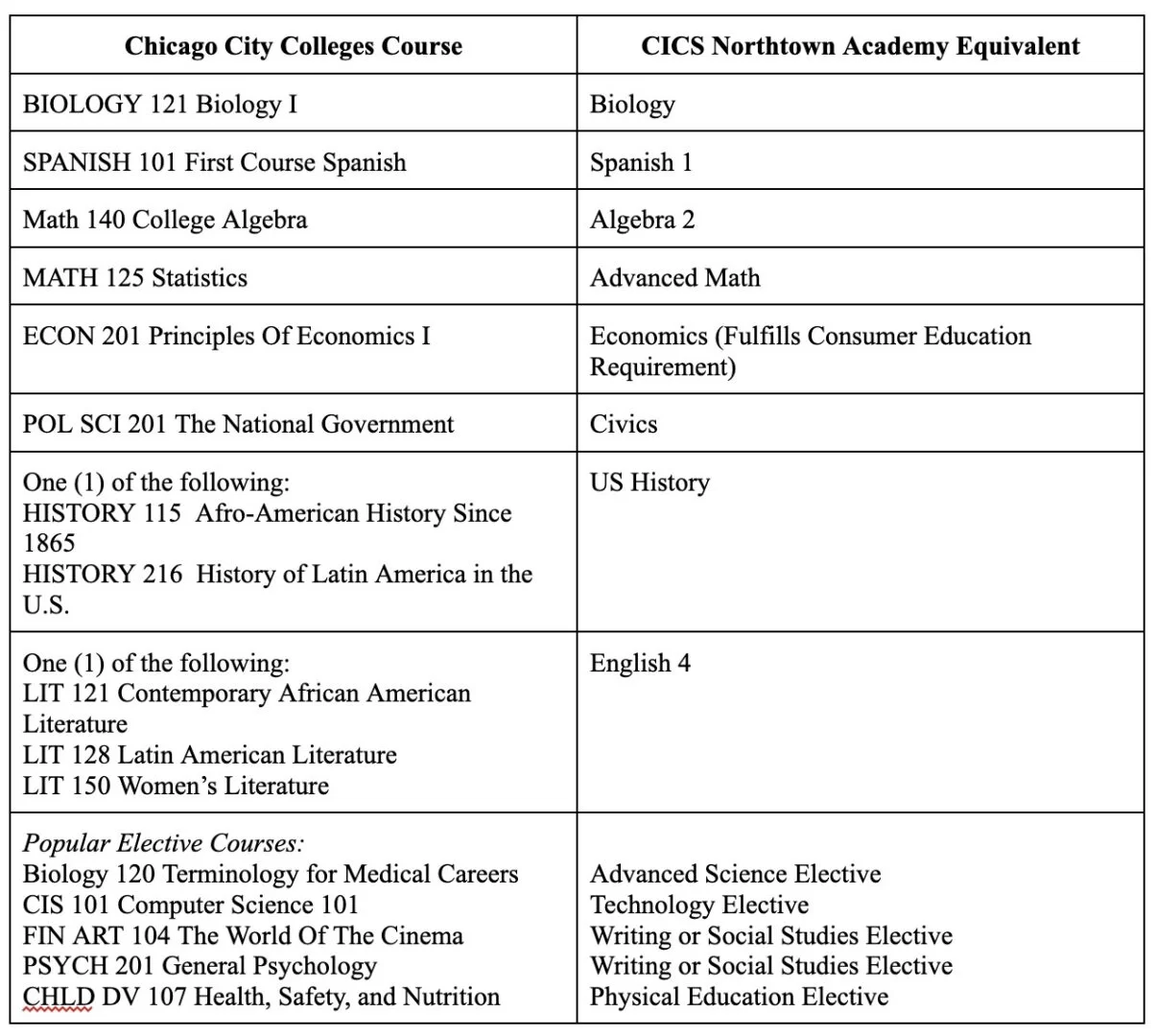
You can speak with your counselor to learn more information on how to sign up for dual enrollment classes. Note: If a student withdraws from a Chicago City College Dual Credit or Dual Enrollment course or earns below a “C” grade, the student must meet with Northtown’s Dual Enrollment Coordinator to discuss whether the student can enroll in a future Dual Credit or Dual Enrollment course.
